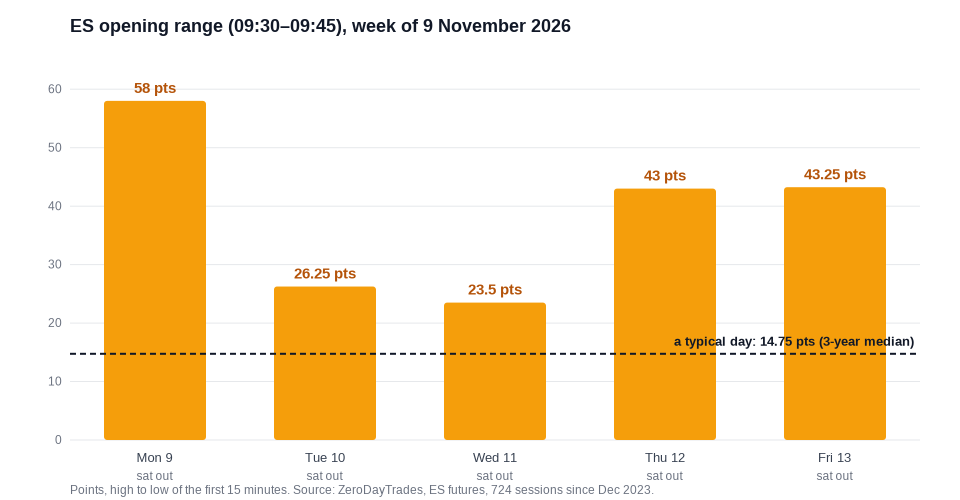
If you were watching, that probably felt wrong. A trading bot that doesn't trade for a week? So we went back and looked at every day.
This wasn't a normal week
On a typical day, ES moves about 15 points in the first fifteen minutes. This week the opening range averaged almost 39 points. Over nearly three years of data, that's bigger than 97% of all weeks. The whole day was just as wild: an average range of about 103 points, against a normal 54.
The bot is built to trade the opening range on normal days. When the open is several times its usual size, the bot steps aside. This week, every single open was outsized, so it stepped aside every day.
Was sitting out the right call?
We replayed the week through the bot's own engine, with its size check switched off, to see what would have happened if it had traded anyway.
- Monday: the breakout would have won. That's the move everyone remembers.
- Tuesday, Wednesday and Thursday: three losing trades in a row.
- Friday: roughly break-even.
Add it up and trading the week would have lost about $1,400 on a single ES contract, after being down as much as $3,800 at the worst point. Monday's winner was given back, and then some.
It feels like an obvious missed move looking back, but most big opening drives like this one stall or reverse, and that's where the losses came from.
That's the trap with a day like Monday. You see the one that worked. You don't feel the three that would have followed it.
Three years say the same
This isn't just one week. Over nearly three years of ES, we looked at every day where the opening range was outsized compared with normal. Breakouts on those days won less than half the time, roughly broke even overall, and produced a worst losing stretch of about $25,600 on one contract. That's more than twice the worst stretch of the trades the bot actually takes.
To be fair, wide days aren't always losers. The week before, the 5 November sell-off was one of those skipped days, and that breakout would have paid well. But you can't know in advance which wide day is the big winner, and over time they cost about as much as they make, with far bigger swings. The bot isn't built to catch those days. It's built to still be standing after weeks like this one.
A bot isn't a human, and that's the point
A human sees one big breakout and feels the miss. The fear of missing out is loudest on exactly the days when the trade is most dangerous.
The bot doesn't feel the miss. It doesn't care about one big move. It looks at what happened over hundreds of sessions, and it does one job: find a day where you can enter safely. A range this wide means a trade this wide, with thousands of dollars at risk on a single contract. So when the range is too wide, the bot waits for a day when the range is a normal size and the risk fits.
What to expect from the bot
- Most weeks, the opening range is a normal size and the bot trades. When markets get violent, it can sit out several days in a row, or a whole week. That's the system working, not failing.
- Over nearly three years, about three days in ten were skipped. In calm months it's fewer; in volatile stretches like this one it's most of them.
- Judge it over months and hundreds of trades, not by one chart or one week.
The full research behind the bot, every losing month included, is on the research page: zerodaytrades.io/research/opening-range-bot/
Hypothetical or simulated performance results have certain limitations. Unlike an actual performance record, simulated results do not represent actual trading. Also, since the trades have not been executed, the results may have under- or over-compensated for the impact, if any, of certain market factors, such as lack of liquidity. Simulated trading programs in general are also subject to the fact that they are designed with the benefit of hindsight. No representation is being made that any account will or is likely to achieve profit or losses similar to those shown. Trading futures involves substantial risk of loss and is not suitable for every investor.