I set a limit order at a level this morning, with part of my attention already pulled toward something else. Price touched it almost immediately, ran through my stop just as fast, and I was out for a loss before I'd even settled into the session.
It would be easy to read that as the order type failing me. It wasn't. It was information: the level got tested and didn't hold the way I expected. The order did exactly what I told it to do, at exactly the price I'd already decided was worth the risk. That's the whole point of a limit order, and it's worth making the case for directly, because "just get in, it's moving" is the more tempting habit for most traders, myself included.
A limit order is a decision made in advance
A market order commits you to whatever price you're looking at in the moment — which means it commits you to whatever you're feeling in the moment. A limit order commits you to a price you decided on earlier, when you were looking at the plan instead of the live tape. One of those decisions is made by the calmer version of you. The other is made by whoever's sitting at the desk when the candle is already moving.
That doesn't mean the limit order guarantees a good outcome. It got me stopped out fast today. But a quick stop on a pre-planned level is a completely different event than a loss taken because I chased a move after it had already happened. One is the cost of a defined process. The other is the cost of not having one.
The part that actually mattered
Getting stopped isn't the interesting part of the morning. What happened in the minutes right after is.
The first trade was straightforward: long at the level, stopped almost immediately when price ran through it. Small loss, quick, exactly the risk I'd already agreed to before I placed the order.
The level pulled back further, held, and started to push back up with real buying behind it — the exact behavior I'd written down beforehand as what I needed to see. I took the second long. Not because I was trying to make back what I'd just lost, and not because I hesitated out of caution either. I took it because it was the setup, on its own terms, completely separate from the trade five minutes earlier. That second trade was the one that put the day green — not despite the first trade, but because the first trade didn't get to decide how I approached the second one.
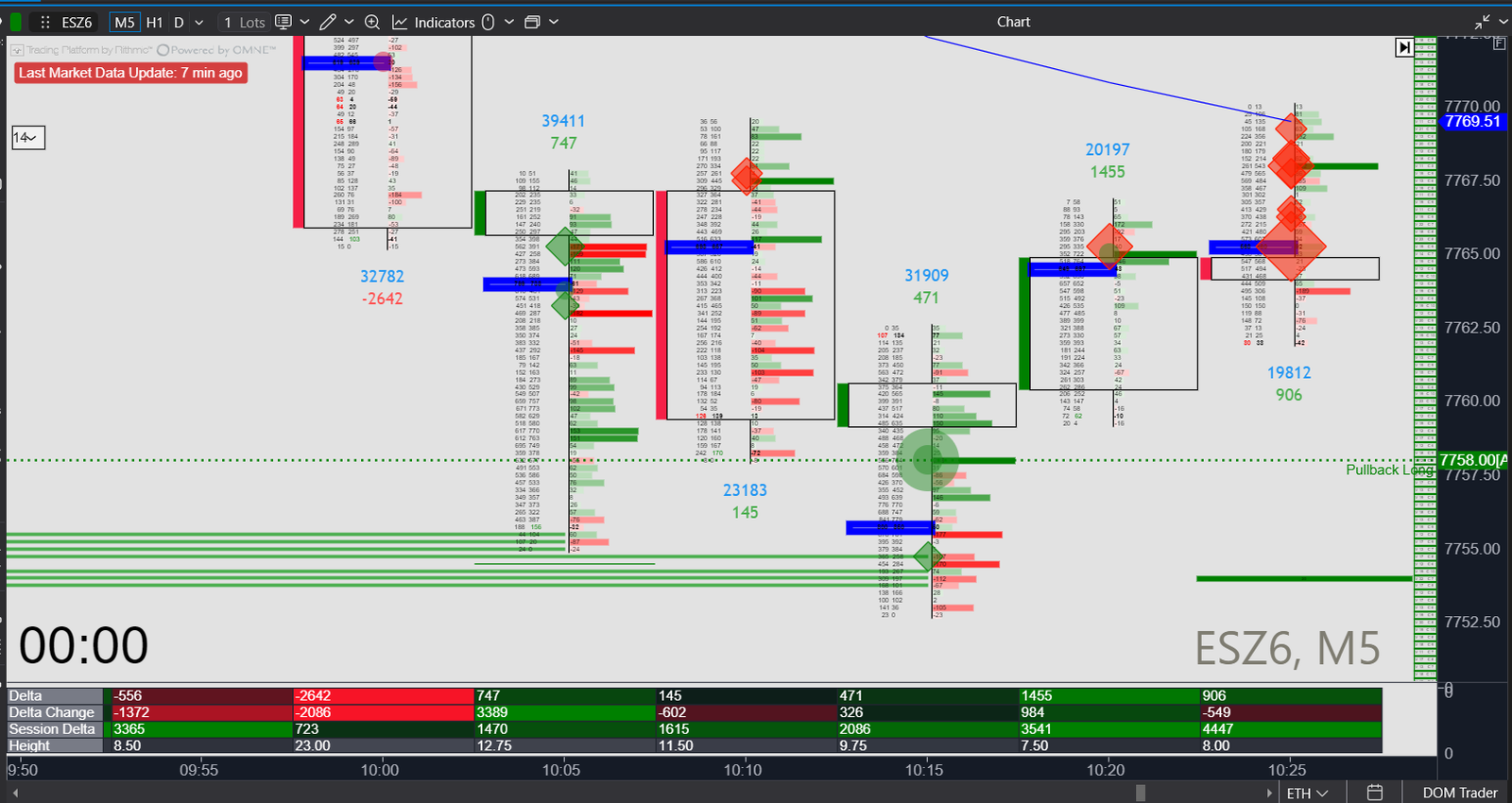
That's the skill that doesn't get talked about enough. Call it amnesia, if you want a word for it: the ability to let a loss be exactly one data point, with no emotional carryover into the next decision. Not toughness, not confidence — just the discipline to judge the next setup only against the plan, not against how the last trade made you feel. The adjustment between those two trades is part of the edge, not a footnote to it.
The stop-out wasn't proof the process failed. It was proof the process was running exactly as designed — take the level, respect the risk, and let the next setup stand entirely on its own.
What actually produces an edge
None of this comes from being right more often than the next person. It comes from the boring stuff, done the same way every day: writing the plan before the session, knowing the levels ahead of time instead of reacting to them live, reading what price is actually doing at those levels rather than guessing, and then — the part most people skip — treating every new setup as its own event, independent of whatever just happened.
A limit order is just the mechanical expression of that discipline. It forces the decision to happen ahead of time, at the price the plan already chose, instead of in the moment the market is moving and every instinct is pulling toward "get in now." Some days that costs a quick stop. Most days, it's the only reason the next trade gets taken cleanly instead of chased.
Written same-day, off one trading session. Not a system, not a guarantee — just the case for doing it the same way regardless of what the last trade did.